
Locating ungrouted voids within PT ducts
Overview/Intro
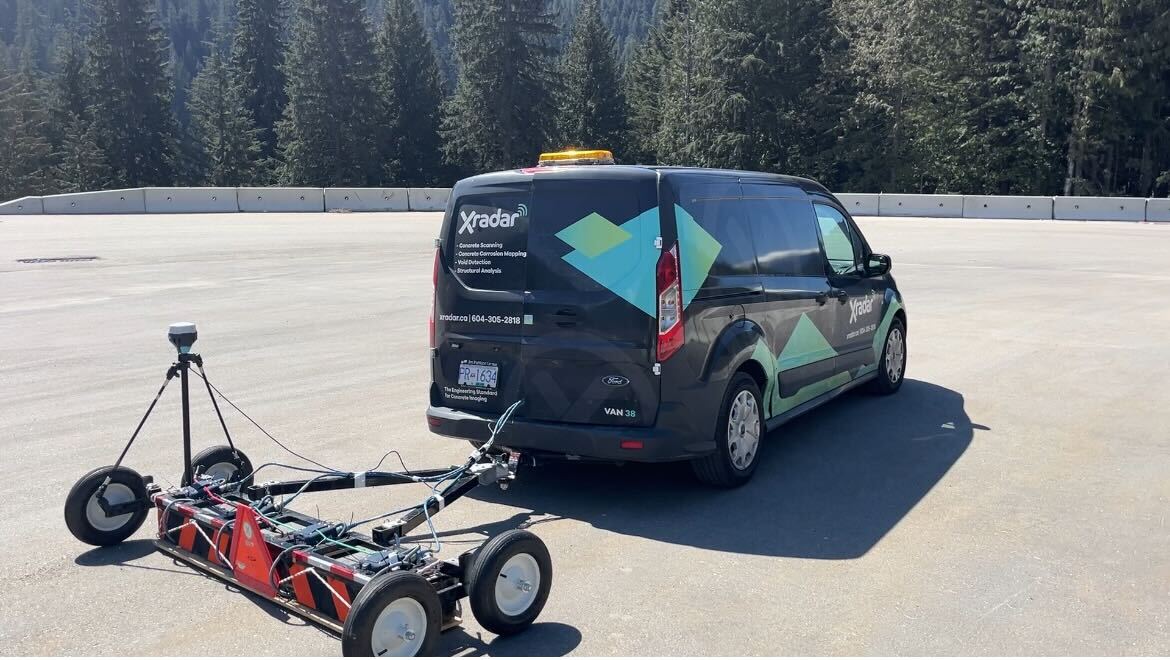
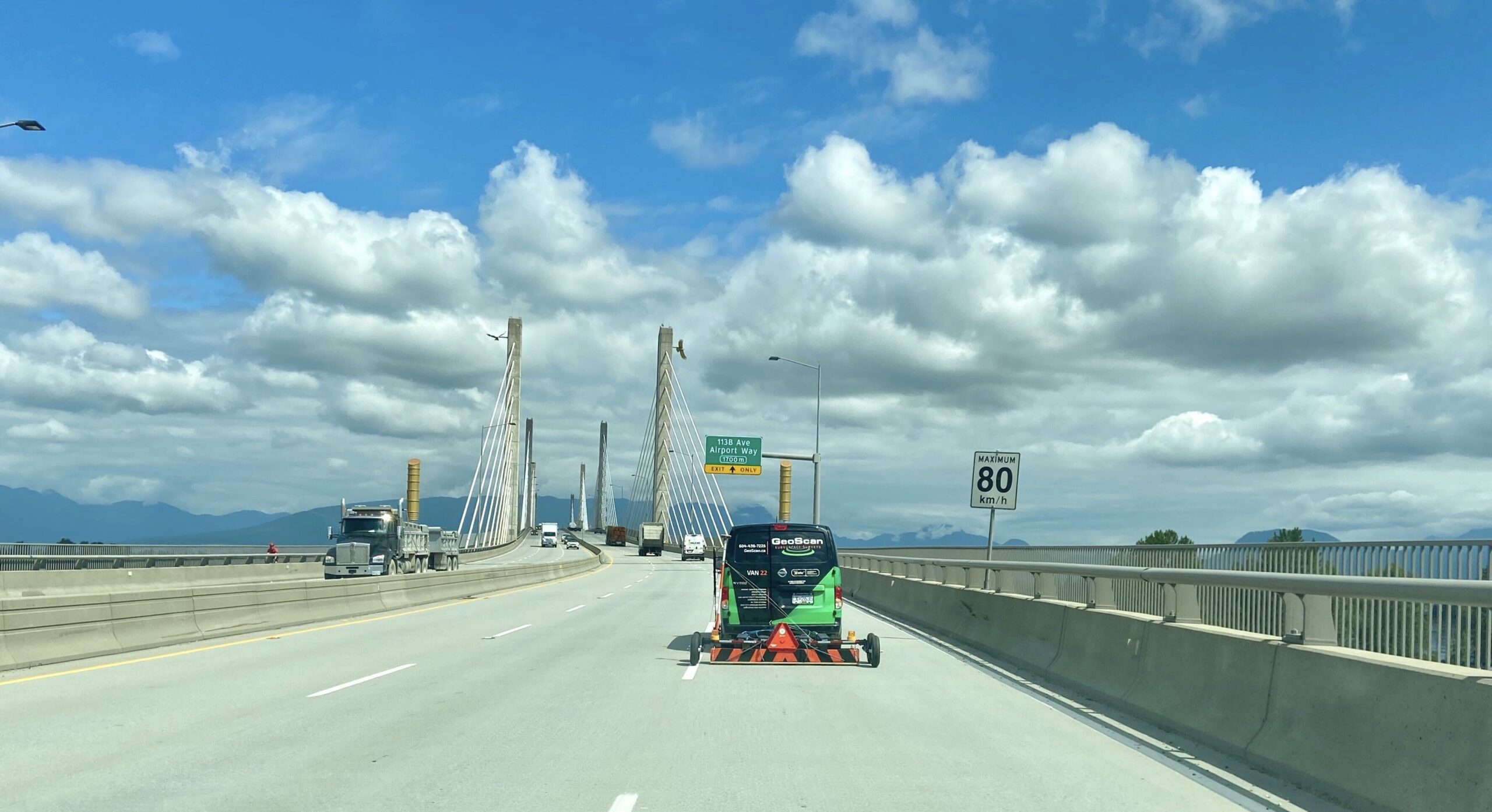
Xradar completed a large scale project of multiple bridge deck structures in one fell swoop, no full closures necessary. Utilizing a multi-channel towed GPR system to provide fast continuous data collection covering multiple structures, with up to six lanes each in a matter of hours.
The Challenge
Multiple bridge structures in the lower mainland were up for review as part of their ongoing maintenance and monitoring program. The structures in question form a significant transport link with up to six lanes on the main bridge span and four on the majority of the trunk road. Assessment was required of all on and off slips as well as cycle lanes.
GPR data collection was to be carried out using rolling traffic control during daytime hours with minimal disruption to everyday traffic. The GPR assessment convoy consists of a primary data collection vehicle towing the GPR array, an Xradar support vehicle and then two traffic control vehicles to provide clear signage, protection and road presence.
In total, over 125km of GPR data was collected in two days. Over 20 passes over the bridge sections required, four channels at a time sampling data at a resolution of 300 traces a second, with individual transects every 50cm from road edge to road edge.
Our Solution
Xradar utilize exclusively ground coupled antennas as opposed to their air coupled counterparts used regularly for roadway assessments. Ground coupled antennas provide far superior data quality and depth penetration as radar signal does not get attenuated by travelling through the air before even reaching the asphalt or concrete surface. This means that the resolution of the final radargrams is much higher and allows for full imaging of the entire slab – vitally important for effective assessment of embedded targets, slab thickness measurements and delamination.
Methodology
Computer assisted visual assessment of reinforcement corrosion is the most accurate and effective method of identifying corrosion from GPR data. The technique surpasses the current ASTM (D6087-08) for deck assessments in terms of accuracy.
The ASTM methodology relies heavily on a limited algorithm that calculates amplitude changes regardless of key factors such as: longitudinal reinforcement, reinforcement distribution and superficial or structural variations (surface defects, changing surface layers e.g. concrete to asphalt). The visual assessment takes all of these factors into account when assessing reinforcement defects undergoing an extensive QC process to ensure results are both reliable and repeatable.
Results/ Conclusion
Conclusion
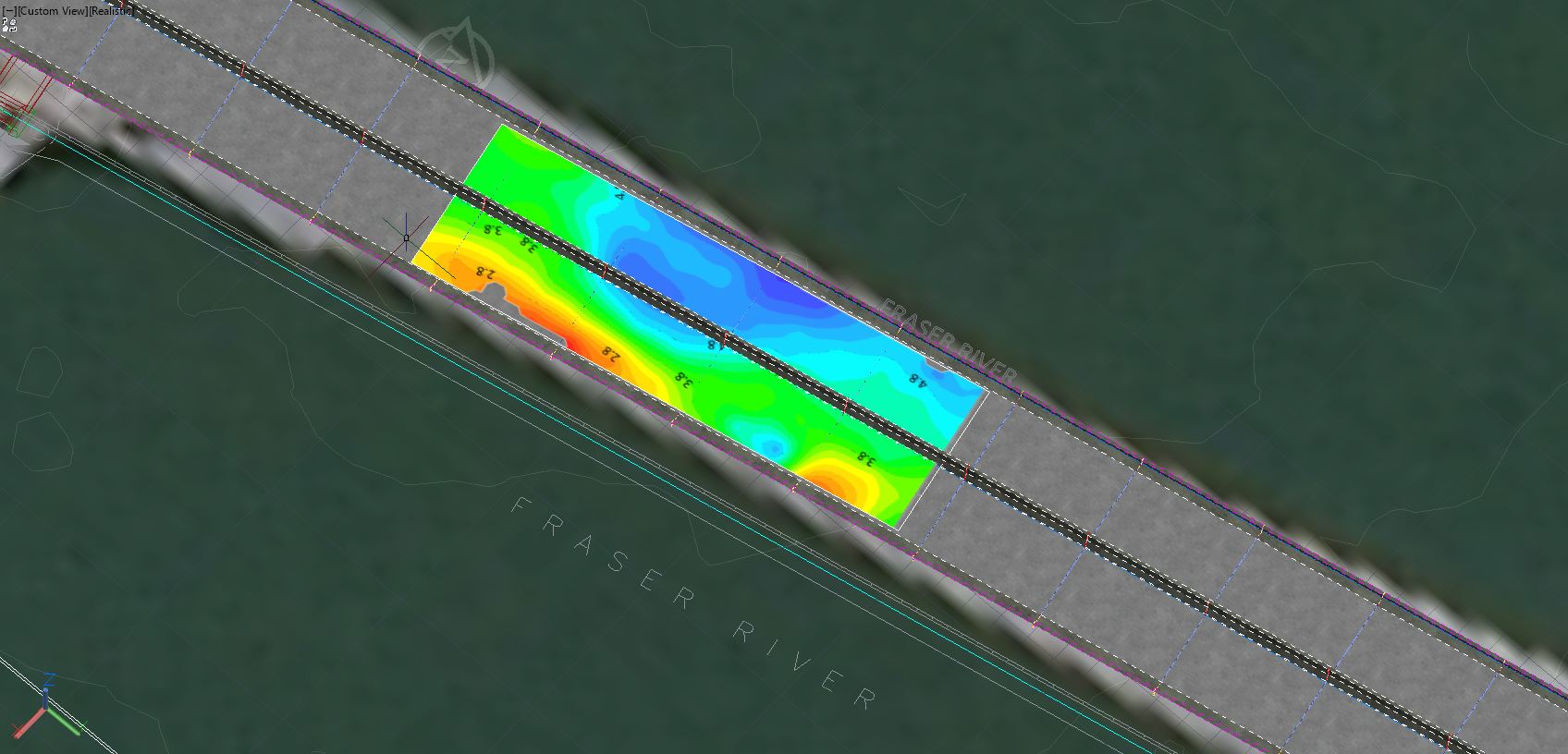
Over 500,000 reinforcement bars were picked from the GPR datasets to produce a comprehensive cover map that was then down-sampled to give an effective resolution of 0.5m. These gridded depth maps could then be contoured, and imported into the CAD model for each structure. Repeating the Xradar corrosion and cover assessment periodically can deliver quantifiable results that form a highly detailed understanding of how the deck reinforcement is developing over its intended lifespan.